Chapter 1—General Reporting Requirements
Chapter 2—Public Outreach and Public Involvement Activities
Boston Region Metropolitan Planning Organization
10 Park Plaza
Suite 2150
Boston, MA 02116
Telephone: 617-973-7100
Fax: 617-973-8855
Karl H. Quackenbush, Acting Director
Alicia Wilson, Transportation Equity Program Manager Boston Region MPO Staff
April 21, 2011
Revised June 13, 2011
This report has been prepared in compliance with requirements set forth in U.S. Department of Transportation Circular 4702.1A of May 13, 2007, “Title VI and Title VI- Dependent Guidelines for Federal Transit Administration Recipients.”
Title VI of the Civil Rights Act of 1964 prohibits discrimination on the basis of race, color, or national origin in programs and activities receiving federal financial assistance. Two Executive Orders and related statutes further define populations that are protected under the umbrella of Title VI. Executive Order 12898 is concerned with environmental justice for minority and low-income populations. Executive Order 13166 is concerned with providing equal access to services and benefits for those individuals with limited English proficiency (LEP).
Each federal agency that provides financial assistance for any program is authorized and directed by the United States Department of Justice to apply provisions of Title VI, Executive Order 12898, and Executive Order 13166 to each program by issuing applicable rules, regulations, or requirements. The Federal Transit Administration (FTA) of the United States Department of Transportation (DOT) issued a circular on May 13, 2007, FTA C 4702.1A, that provides guidance to recipients of FTA financial assistance for carrying out the DOT’s Title VI regulations (49 CFR part 21) and integrating the DOT’s Order on Environmental Justice (Order 5610.2) and Policy Guidance Concerning Recipients’ Responsibilities to Limited English Proficient Persons (70 FR 74087) into their programs and activities.
This document explains the Title VI program of the Boston Region Metropolitan Planning Organization (MPO). This program, conducted in cooperation with the Massachusetts Department of Transportation (MassDOT), is consistent with the principles of Title VI, federal guidelines, and related requirements and is responsive to the needs of Title VI beneficiaries.
Chapter 1 addresses the MPO’s general reporting requirements under the circular, specifically the:
Chapter 2 describes the MPO’s public outreach and public participation activities and highlights how the MPO reaches out to minority, LEP, and low-income populations.
Chapter 3 provides an assessment of the MPO’s planning process, a demographic profile of the MPO area, a description of the strategies used to identify the needs of low-income and minority residents, and a description of the analytical processes the MPO uses to assess the benefits and burdens of metropolitan transportation system investments for different socioeconomic groups.
The MPO’s signed Title VI assurances are provided beginning on page 5.
The MPO has developed the following notice to the public of protection under Title VI:
The Boston Region Metropolitan Planning Organization (MPO) fully complies with Title VI of the Civil Rights Act of 1964 and related statutes and regulations in all programs and activities. The MPO does not discriminate on the basis of race, color, national origin, English proficiency, income, religious creed, ancestry, disability, age, gender, sexual orientation, gender identity or expression, or military service. Any person who believes herself/himself or any specific class of persons to have been subjected to discrimination prohibited by Title VI or related statutes or regulations may, herself/himself or via a representative, file a written complaint with the MPO. A complaint must be filed no later than 30 calendar days after the date on which the person believes the discrimination occurred.
MPO meetings are conducted in accessible locations, and materials can be provided in accessible formats and in languages other than English. If you would like accessibility or language accommodation, please contact the MPO at (617) 973-7100 (voice), (617) 973-8855 (fax), (617) 973-7089 (TTY), or publicinformation@bostonmpo.org (e-mail).
This statement is posted on the MPO’s website along with the procedures for filing a complaint described in the next section of this report and the MPO’s complaint form. This notice is also included in all public-outreach materials.
In order to comply with 49 CFR Section 21.9(b), the MPO has developed procedures for receiving, investigating, addressing, and tracking Title VI complaints. The MPO’s complaint procedures and forms are in Appendix I.
The MPO has not been the recipient of any complaints or lawsuits, and no investigations have been initiated.
It is the policy of the MPO that people with limited English proficiency (LEP) be neither discriminated against nor denied meaningful access to and participation in the programs and services provided by the MPO. The MPO has developed an LEP plan to be sure that it employs appropriate strategies in assessing needs for language services and in implementing language services that provide meaningful access to the planning process and to published information without placing undue burdens on the MPO’s resources.
This plan is in Appendix II.
The MPO facilitates and encourages the involvement of minority, low-income, disabled, elderly, and limited-English-proficiency persons in its activities. As described below, it reaches out to these populations through its Public Participation Program (including its process for developing the metropolitan transportation planning certification documents), its Transportation Equity Program, its Coordinated Human-Services Transportation planning, and the Access Advisory Committee to the MBTA.
The MPO utilizes a variety of approaches to providing for communication and consultation with interested parties and members of the public and is continually working to improve its outreach. This section will summarize the activities conducted and the outreach methods used by the MPO in implementing its public participation program.
Full details of the MPO’s program are included in Appendix III, The Boston Region Metropolitan Planning Organization Public Participation Program (June 28, 2007; revised April 1, 2010).
The MPO conducts a varied and ongoing program for gathering information and views from all sectors of the public for its transportation planning and programming work.
Some activities are focused specifically on the development of the certification documents. Others are ongoing and provide input year-round. All activities are open to the public and all MPO-sponsored activities are held at locations accessible for people with disabilities. The locations are well dispersed through the region, include environmental justice communities, and are almost always served by public transportation. In conducting its activities, the MPO strives to meet the needs of people requiring special services such as translation for non-English speakers, American Sign Language interpreters, large-format printed materials, audiotapes, Braille materials, and escorts. Meeting materials are available in accessible formats and in Spanish and other languages, on request.
MPO activities include:
MPO outreach methods generally serve either or both of two purposes: notification, and provision of informational materials and reports. The MPO works to maintain state-of- the-practice capabilities in its methods.
Certification documents, other reports, informational materials, and notices are obtainable upon request in varied formats, including audiotapes, compact discs, audio compact discs, Braille, Teletype, and large-format prints. All documents are posted on the MPO website. Consideration is given to the use of formats other than PDF, improve accessibility for people with disabilities. Members of the public may request meeting materials, in standard or accessible formats, by e-mail, telephone, fax, or by U.S. mail.
The MPO provides public notifications in a variety of ways, such as legal notices, press releases for all regional and local newspapers (including Spanish-language press releases for the two major Spanish-language newspapers), e-mailing of flyers and notices, and direct mailing of notices of the availability of draft documents on compact disc (CD) to local officials, regional equity contacts, and other interested parties. The MPO’s newsletter, TRANSreport, publishes notices and discusses issues. Organizations providing support for persons with disabilities also forward MPO notices to their constituents in accessible formats.
Notices are also distributed via the MPO’s one-way listserve, MPOinfo, or the e-mail groups for the Transportation Planning and Programming Committee, the Advisory Council, the Transportation Equity Program, TIP Contacts, and AACT members.
MPOinfo has more than 1,200 contacts and includes local officials, legislators, transit service providers, councils on aging, chambers of commerce, regional employment boards, community development corporations, other social service organizations, members of the public who have attended meetings, and many other interested parties.
The MPO’s website posts notices of public outreach and is an important method for distributing information to everyone with Internet access. It is a broad-based resource for people interested in MPO activities, notices, meeting minutes (including those for the MPO, the Transportation Planning and Programming Committee, the Advisory Council, and AACT), reports, documents, and studies. It also hosts and links to extensive transportation data about the region and other transportation planning information.
Website users are invited to submit comments electronically through the prominent “Submit a Comment” and “Share Your Views” buttons on the home page and on each certification document’s page. The website is accessible to people who are visually impaired. It is equipped with the BabelFish software that translates posted text into 12 languages, including those most frequently spoken in the region.
The MPO’s monthly newsletter, TRANSreport, is used as a means to provide information on the MPO planning process. Every issue reports on upcoming transportation-related public meetings and events, MPO activities, MPO and agency studies, and how to contact MPO staff with ideas, questions, and comments. Occasionally issues include postage-paid survey inserts asking for input and ideas. TRANSreport is sent by mail and electronically to nearly 3,000 recipients. Issues are posted on the MPO website each month and later archived.
The MPO prepared the booklet “Be Informed, Be Involved” as a resource to provide information about the MPO’s planning process. The booklet has been translated into Spanish (“Infórmese, Involúcrese”) and is available on the MPO’s website. MPO staff placed supplies of the booklet in all public libraries and main municipal office buildings,and the MPO distributes these booklets or other summaries describing the MPO and the 3C process at outreach events, including Transportation Equity events.
Flyers and notices are distributed at meetings of the Transportation Planning and Programming Committee, the Advisory Council, AACT, the Rider Oversight Committee to the MBTA, and the MAPC subregions, as well as posted in key locations at the State Transportation Building.
The MPO has an established process for considering the transportation needs and views of underserved constituencies, including communities of low-income, LEP, and minority residents. The MPO developed its Transportation Equity Program in order to have a systematic method of considering environmental justice in all of its transportation planning work. The program builds on the foundation of ongoing outreach concerning transportation needs and previous analyses of accessibility and mobility for low-income and minority communities in the Boston region. The findings from this work have been incorporated in the development of a number of MPO documents, including the 2000– 2025 Long-Range Transportation Plan (LRTP), the 2000–2025 LRTP Addendum and Update, the 2004–2025 LRTP, the 2007–2030 LRTP (JOURNEY TO 2030), the upcoming LRTP (Paths to a Sustainable Region), and recent Transportation Improvement Programs (TIPs) and Unified Planning Work Programs (UPWPs).
The MPO has adopted the following definition of environmental justice:
Environmental justice requires the MPO to:
The MPO’s Transportation Equity Program is composed of three key elements: community outreach, incorporation of environmental justice in the planning process, and analysis of the effects of planned transportation projects.
The MPO takes a proactive, grassroots approach to identifying and articulating environmental justice issues in the region. Methods include:
In carrying out these methods, the MPO has identified social service and community contacts involved in and knowledgeable about the transportation needs of environmental justice populations. These contacts include social service organizations, cultural and ethnic organizations, community development corporations, regional employment boards, civic groups, business and labor organizations, transportation advocates, environmental groups, and environmental justice/civil rights groups.
Information about the transportation needs of minority, LEP, and low-income populations is primarily collected through one-on-one and small-group interviews and meetings with community contacts, surveys, and larger MPO focus groups or forums.
MPO staff seek to initiate interviews at the offices of representatives of community organizations to discuss transportation needs and burdens. In this way, the MPO facilitates the participation of some of the people best positioned to speak about the transportation needs of environmental justice areas, who might not otherwise have the time or financial resources to travel to meetings in a central location or to participate in public forums.
During these meetings, the MPO is able to both obtain information about the transportation needs of the area and inform participants about the MPO and the metropolitan planning process. Information and surveys are mailed to community contacts prior to these meetings to help participants prepare. These materials are also sent to those who are unable to schedule time for an interview.
A transportation equity survey is posted on the MPO website to help individuals identify transportation needs and problems in their communities. Postcards announcing the survey were sent to all of the transportation equity contacts. Comments obtained from the online survey are summarized and forwarded to appropriate agencies and communities. The MPO will continue this initiative and conduct additional surveys periodically.
Communication is ongoing, as MPO staff keep community organizations updated with information concerning MPO planning activities and continue to solicit information and views. The MPO also encourages contacts to participate in all scheduled MPO meetings and forums.
MPO staff interpret, summarize, and classify the needs identified by each participant in the outreach process as related to the LRTP, the TIP, the UPWP, service planning, and other planning processes. This information, along with copies of surveys, maps, and any other notes and information, has been compiled in briefing books and tables for review by community representatives and as input to MPO work. The briefing books are also available to interested parties in environmental justice areas.
The MPO provides feedback to community partners involved in the MPO transportation equity process by providing a written summary of their needs for their review. They are informed of which classification(s) each of their needs has been given: LRTP, TIP, UPWP, service planning, or other. Communication is ongoing, as the MPO staff keep community partners updated with information. A summary of current and planned MPO activities (including MPO-sponsored meetings and open houses and workshops or meetings sponsored by other agencies, if known) that are related to the community’s needs may also be included.
The MPO will continue to expand its outreach to neighborhoods of concern and broaden its direct contacts with minority, LEP, and low-income residents in these communities. The goal is to identify specific community needs and to facilitate answers and possible actions by responsible agencies. Assistance in reaching some solutions will involve coordination with the Operations and Service Planning departments of the MBTA and the Office of Transportation Planning at MassDOT.
The MPO’s Coordinated Public Transit Human-Services Transportation Plan (CHST Plan) provides guidance for improving transportation services for people with disabilities, elderly individuals, people with low incomes, and reverse-commuters in the Boston region and facilitates the coordination of public transit and human-services transportation resources. The federal legislation that funds surface transportation, SAFETEA-LU, established that recipients of funding from any of three Federal Transit Administration human-services transportation programs, (1) Elderly Individuals and Individuals with Disabilities (Section 5310), (2) Job Access and Reverse Commute (JARC; Section 5316), and (3) New Freedom (Section 5317), must certify that the projects to be funded have been selected from a locally developed, coordinated public transit–human services transportation plan, such as the CHST Plan.
The CHST Plan was developed with the participation of representatives of public, private, and nonprofit transportation and human-services providers, as well as members of the public. The MPO held public planning forums to discuss the MPO’s Draft Interim CHST Plan, the needs of the target populations in the region, and strategies for meeting those needs. MPO staff made a presentation and used a survey to guide these discussions. Input received from these forums and comments received from the public (via the MPO’s website, by e-mail, and by telephone) were integrated into the CHST Plan and helped define the priorities for funding projects under these programs.
The MPO completed the first solicitation for proposals to be considered for funding in the JARC and New Freedom programs on July 18, 2008. (JARC-funded projects are intended to improve access to jobs and employment-related activities for low-income individuals and transport residents of urban areas to suburban jobs. The New Freedom program improves mobility for people with disabilities via projects that go beyond Americans with
Disabilities Act [ADA] requirements.) Three additional requests for proposals have been completed since this date. A total of 36 MPO proposals have been or are in the process of being funded. Submittals from these solicitations have included a wide range of proposed projects demonstrating local and regional initiative in addressing the mobility needs of people with low incomes, people with disabilities, and reverse-commuters in the region. The Transportation Planning and Programming Committee selects proposals to advance into MassDOT’s competitive selection process that includes proposals from all five MPOs in the Boston Urbanized Area.
The Access Advisory Committee to the MBTA (AACT) is a consumer advocacy organization composed primarily of people with disabilities, senior citizens, and representatives of human service agencies. The MPO funds staff support for AACT. Working closely with the MBTA, AACT strives to ensure that the transportation system of the Boston region is accessible, in addition to being safe and efficient, as guaranteed by the Americans with Disabilities Act (ADA). AACT meets once a month to coordinate with MBTA officials and paratransit operators, to identify accessibility problems in the system, and to work on solutions. All meetings are open to the public. MPO staff coordinate the activities of AACT. In February 2011, staff conducted a workshop for all MPO staff members on how to be sensitive to the needs of persons with disabilities.
The MPO provides for non-discrimination in transit planning and programming through oversight and representation by its members; by following federal legislation and the 3C (continuing, cooperative, and comprehensive) transportation planning process; by reflecting the legislation in its objectives, policies, and plans; and by having non- discriminatory development and implementation processes for its LRTP, TIP, and UPWP.
Transportation equity/environmental justice is an integral part of the MPO transportation planning process. MPO policy promotes the equitable sharing of the region’s transportation system benefits and burdens as well as participation in decision making.
As a first step in its long-range planning and in developing its LRTP, Paths to a Sustainable Region, the MPO adopted seven visions, each with an associated policy, that guide its planning processes. Two of the visions and their policies explain the MPO commitment to promoting equity and accessibility for all:
These policies are applied in assessing projects for inclusion in the LRTP, in developing MPO criteria for evaluation and selection of projects for the TIP; in selecting and defining studies for the UPWP, which includes MPO staff support for the MBTA’s Title VI reporting work; and in supporting the MPO’s ongoing transportation equity/environmental justice program.
The 3C process in the Boston region is the responsibility of the MPO, which has established the following objectives for the process:
The MPO is responsible for carrying out and completing all transportation plans, programs, and conformity determinations required by federal and state laws and regulations through the 3C process. This includes preparation of the major certification documents: the LRTP, the UPWP, the TIP, and all required air quality analysis. The MPO also initiates studies to identify transportation needs and solutions, and programs financial resources for the region’s multimodal transportation system. The following is a brief description of each of the certification documents:
The following demographic profile is based on the 2000 U.S. census. Though the 2010 census minority population data at the tract level was released on March 22, 2011, the household income data have yet to be released at the tract level. MPO staff have determined that the 2005–2009 American Community Survey (ACS) sample data have high margins of error at the tract level for minority population and did not use it as the source.
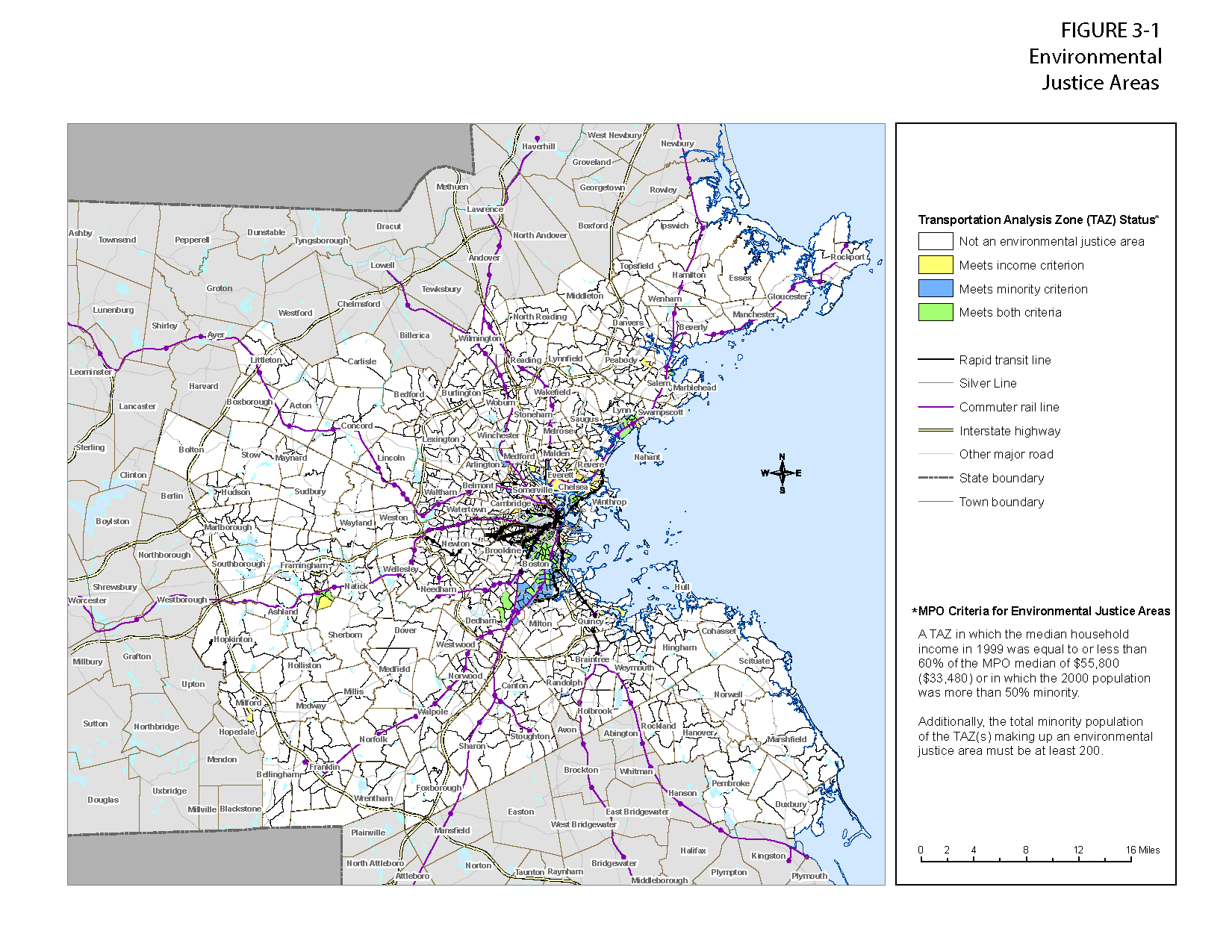
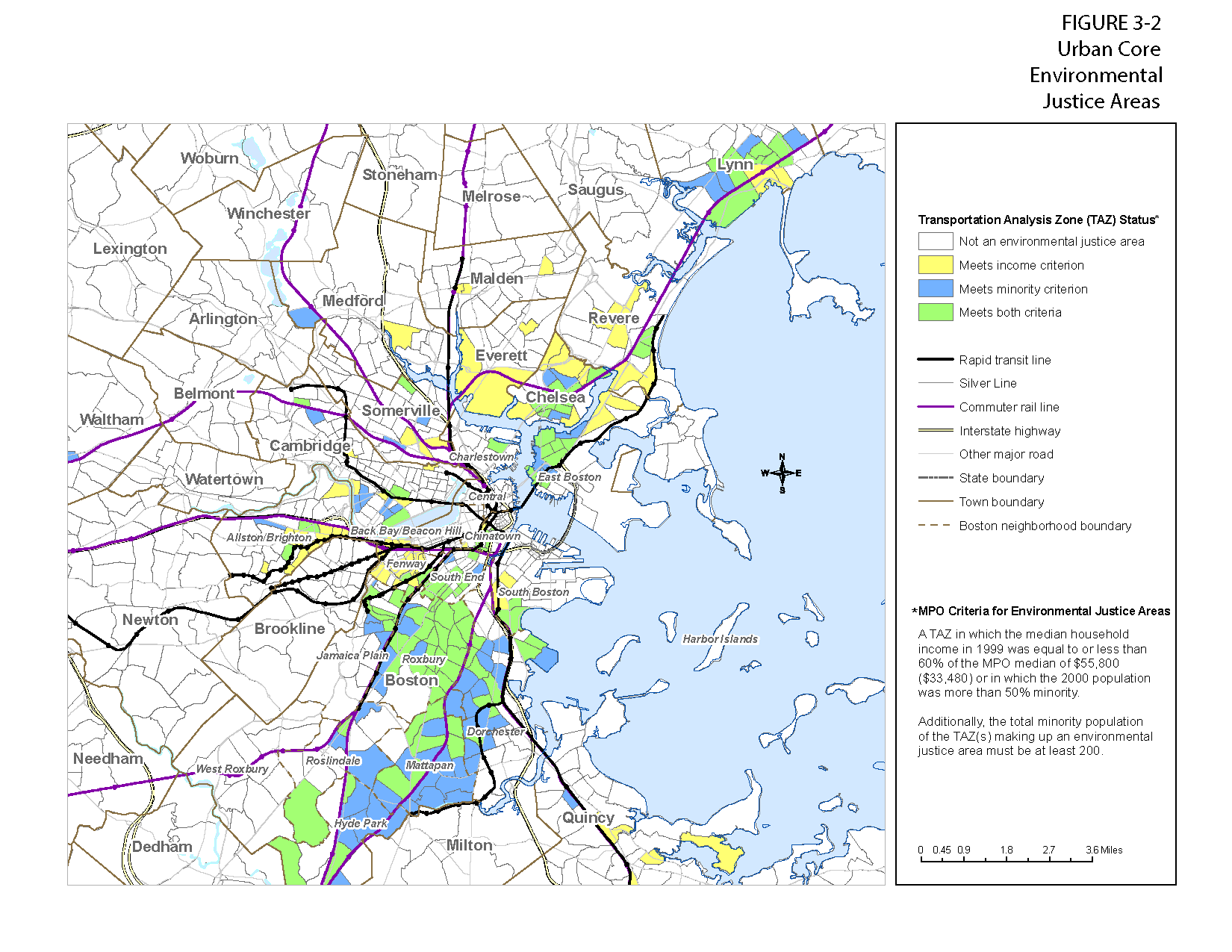
The MPO conducted a demographic analysis of the Boston region by transportation analysis zone (TAZ); a TAZ is defined by demographic information (population, employment, and housing) and the number of trips produced and attracted within its borders. The income levels and percentages of minority populations in all TAZs in the region were identified. The MPO used the results of this analysis to identify areas with large concentrations of minority and/or low-income residents for its transportation equity outreach and environmental justice analyses. Low-income TAZs were then defined as areas with income levels at or below 60 percent of the MPO area median household income (60 percent of the region’s median household income of $55,800 is $33,480). The MPO adopted this income threshold from a U.S. Department of Housing and Urban Development definition of low-income households.1 Minority TAZs are those in which the non-white or Hispanic population is greater than 50 percent and includes a minority population of at least 200 people. Any TAZ which qualifies as either minority or low- income is considered an environmental justice area and is a target of the MPO’s Transportation Equity Program outreach.
Table 3-1 shows the demographics (total population, minority population, and percent of the MPO’s median household income) for all of the TAZs within a municipality or neighborhood that meet the minority or low-income threshold. Figures 3-1 and 3-2 show the locations of the environmental justice areas in the region and urban core, respectively.
The outreach component of the Transportation Equity Program (discussed in Chapter 2) is a major source of information concerning the transportation issues and needs confronting low-income, LEP, and minority residents of the MPO region. MPO staff interpret the needs identified by each community and classify them as related to the LRTP, the TIP, the UPWP, service planning, or another planning process. The LRTP-related needs are a focus of the LRTP needs assessment. The TIP-related needs are identified in the TIP project information forms and in the TIP itself, and they inform the community impacts criteria category in the TIP ratings matrix. The UPWP-related needs are referred to the Transportation Planning and Programming Committee’s UPWP Subcommittee for possible development of an MPO study. The service planning needs are submitted to the MBTA during the service plan development period. Other needs are referred to appropriate entities.
The MPO provides feedback to community partners involved in the MPO transportation equity process by providing a written draft summary of their needs for their review, with the needs classified as LRTP, TIP, UPWP, service planning, and other. Communication is ongoing, as the MPO staff keep community partners updated with information. A summary of current and planned MPO activities (including MPO-sponsored meetings and open houses, and workshops or meetings sponsored by other agencies, if known) that are related to the community’s needs may also be included.
Additional information about the transportation needs of minority, LEP, low-income, elderly, and disabled people is collected in the MPO’s general public-participation program and its Coordinated Human-Services Transportation planning. This information is integrated with the findings of the transportation equity outreach, and it is used to inform MPO planning activities.
Location of Environmental Justice Area (EJA) |
Total Population of Municipality/ Neighborhood |
Total Population of EJA |
Minority Population of EJA |
Percent of EJA Population That Is Minority |
EJA’s Median Household Income as a Percent of the Region’s Median Household Income |
Allston/Brighton |
69,600 |
27,932 |
11,073 |
40% |
47% |
Cambridge |
101,355 |
22,921 |
14,195 |
62% |
60% |
Charlestown |
15,100 |
3,627 |
2,593 |
71% |
27% |
Chelsea |
35,080 |
34,535 |
21,492 |
62% |
54% |
Chinatown |
10,100 |
7,429 |
4,736 |
64% |
30% |
Dorchester |
76,550 |
53,596 |
42,157 |
79% |
67% |
East Boston |
38,300 |
30,241 |
17,011 |
56% |
52% |
Everett |
38,037 |
2,956 |
978 |
33% |
52% |
Fenway |
38,217 |
33,565 |
10,924 |
33% |
43% |
Framingham |
66,910 |
11,247 |
6,121 |
54% |
50% |
Hyde Park |
36,796 |
23,214 |
17,403 |
75% |
70% |
Jamaica Plain |
36,282 |
13,547 |
10,106 |
75% |
47% |
Lynn |
89,050 |
38,004 |
23,042 |
61% |
46% |
Malden |
56,340 |
2,387 |
920 |
39% |
56% |
Mattapan |
51,204 |
50,966 |
48,779 |
96% |
60% |
Medford |
55,765 |
6,109 |
2,247 |
37% |
78% |
Milford |
26,799 |
2,977 |
516 |
17% |
56% |
Peabody |
48,129 |
3,141 |
682 |
22% |
43% |
Quincy |
88,025 |
7,745 |
2,131 |
28% |
49% |
Randolph |
30,963 |
1,622 |
876 |
54% |
88% |
Revere |
47,283 |
11,959 |
4,213 |
35% |
51% |
Roslindale |
29,030 |
12,344 |
8,477 |
69% |
62% |
Roxbury |
56,220 |
55,747 |
52,296 |
94% |
50% |
Salem |
40,407 |
2,921 |
2,173 |
74% |
47% |
Somerville |
77,478 |
7,224 |
3,189 |
44% |
52% |
South Boston |
31,130 |
8,500 |
3,756 |
44% |
31% |
South End |
29,911 |
16,306 |
12,441 |
76% |
42% |
Waltham |
59,226 |
1,788 |
919 |
51% |
78% |
TOTAL |
1,379,287 |
494,550 |
325,446 |
66% |
|
Source: 2000 US Census
The potential impact of a proposed project in environmental justice areas is considered in the Plan, TIP, and UPWP project-ranking processes. Environmental justice analyses for the Plan and TIP are funded in the UPWP. In these analyses, MPO staff give projects positive or negative ratings on environmental justice criteria based on the estimated benefit or burden to environmental justice areas. The MPO considers these ratings when deciding what projects should receive funding. Environmental justice is a factor that the MPO also considers when determining which studies should be included in the UPWP.
The MPO performs a systemwide analysis of benefits and burdens for three different scenarios: existing conditions, the set of projects that are currently funded by the MPO, and the set of projects recommended in the Plan. The analysis focuses on mobility, accessibility, and emissions for communities with a high proportion of low-income and minority residents. Chapter 14 of JOURNEY TO 2030 details the results of the analysis conducted for that Plan; this chapter is provided as Appendix VII of the present Title VI report. (The upcoming LRTP will include this type of analysis as well.)
The MPO used three categories of performance measures in the analysis:
These analyses, based on TAZs throughout the region, are conducted to evaluate the impact of proposed Plan projects on both environmental justice areas and non- environmental justice areas. The MPO conducts the accessibility analyses for the areas identified as low-income or minority for the outreach program, identified, above.
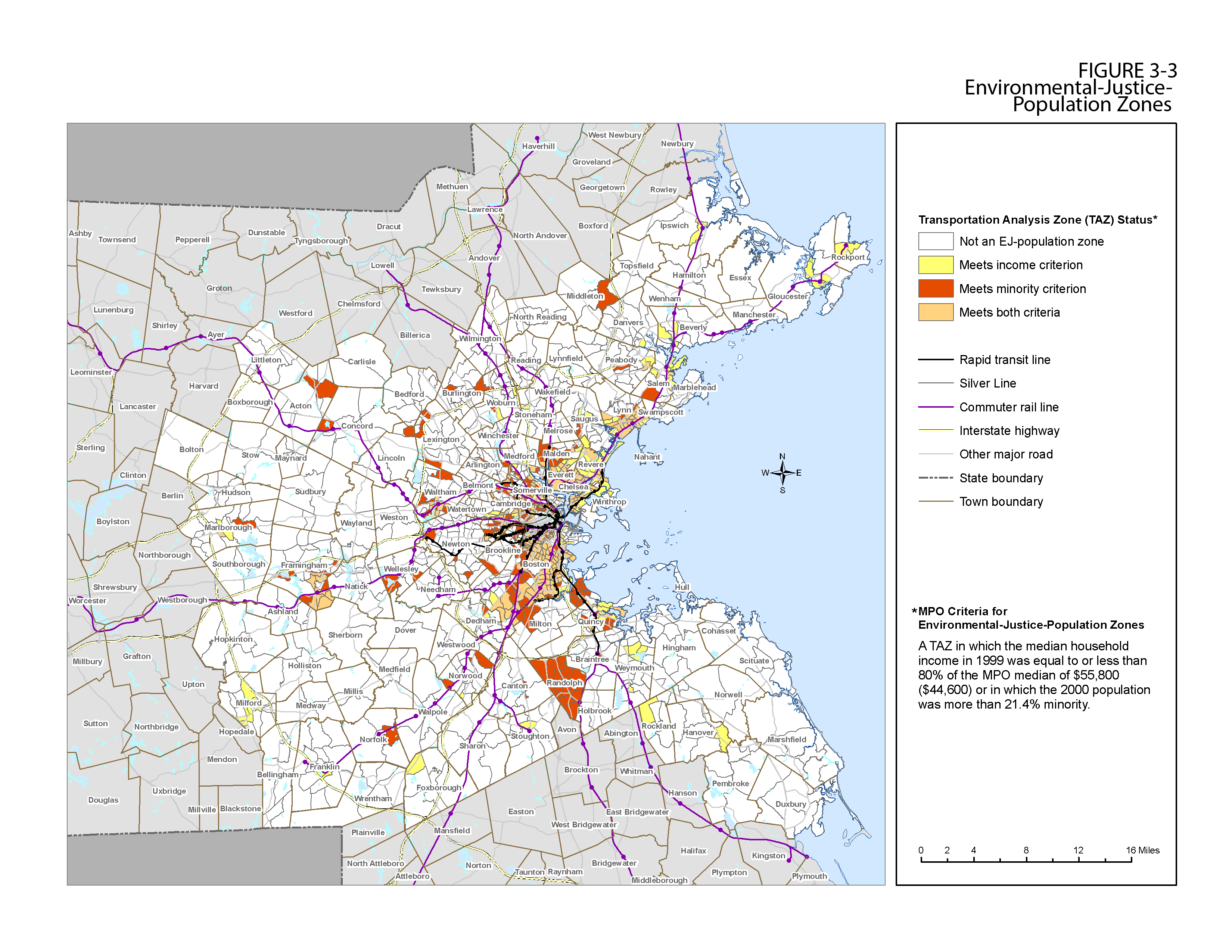
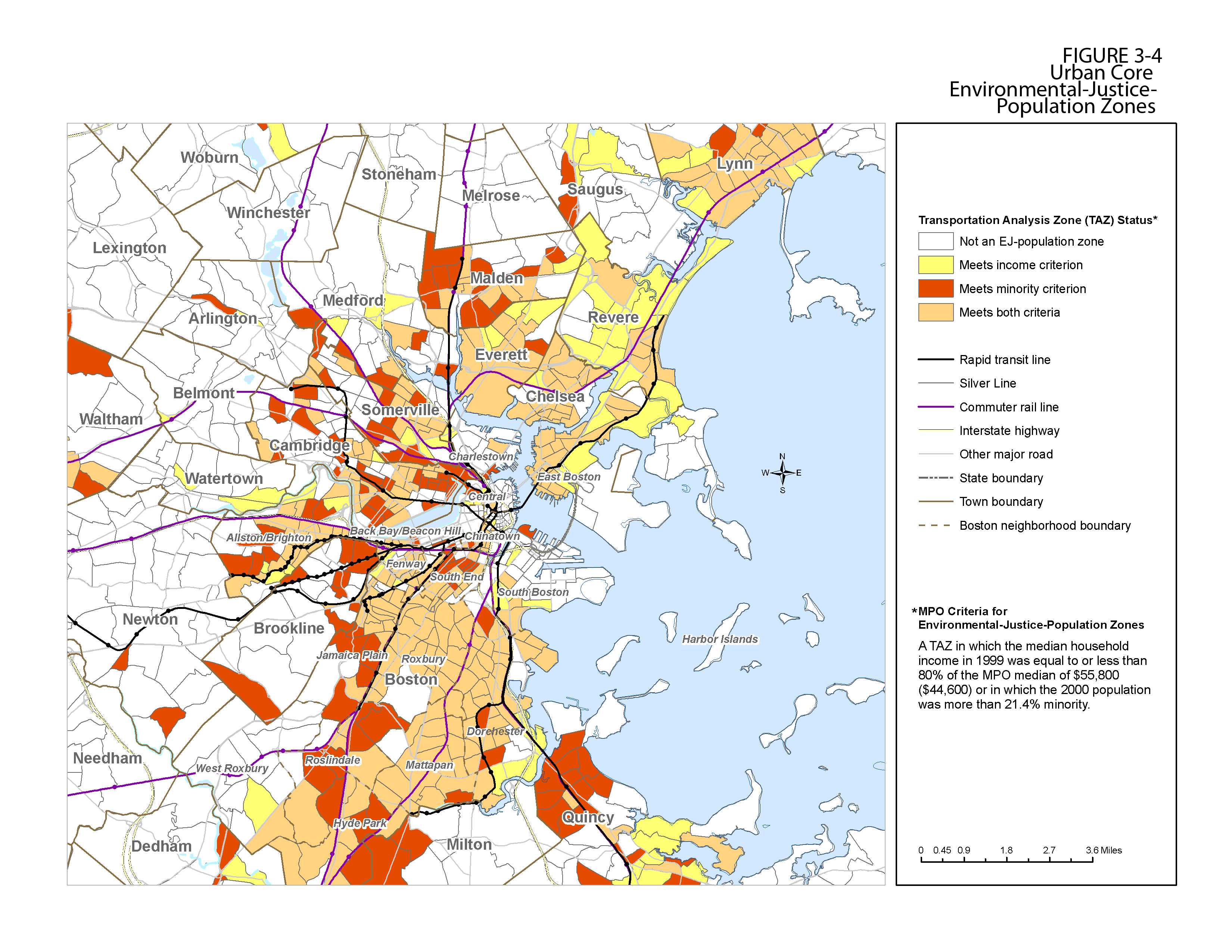
When performing systemwide mobility and environmental analyses, the MPO broadened the minority and low-income criteria to define EJ population zones that are more inclusive than EJ areas. In EJ population zones, low-income TAZs are defined as areas with income levels at or below 80 percent of the MPO area median household income (80 percent of the region’s median household income of $55,800 is $44,640), and minority TAZs are those in which the non-white or Hispanic population is greater than 21.4 percent (which is the minority percentage of the MPO population) and totals at least 200 people. The EJ population zones that are used for the systemwide mobility and environmental analyses are shown in Figure 3-3 for the region and Figure 3-4 for the urban core.
The results of the accessibility, mobility, and environmental analyses are used to understand how a proposed set of projects might affect the environmental justice areas/zones as compared with the non-environmental-justice areas/zones in the region. The analysis of the projects included in JOURNEY TO 2030 showed that the projects recommended in the final LRTP benefit environmental justice areas more overall than they benefit non-environmental-justice areas. Appendix VII contains a more in-depth discussion of these analyses.
The TIP is developed with consideration of the impacts of the proposed projects on MPO environmental justice areas. The MPO uses a set of evaluation criteria to evaluate each project proposed for inclusion in the TIP. There are 35 criteria, three of which are specific to environmental justice. All projects are rated as to whether the project benefits or creates burdens for environmental justice TAZs. The following values are used to rate projects in or contiguous to environmental justice areas (as defined by the income and minority population criteria used for assessing accessibility) and environmental justice zones (as defined by the income and minority population criteria used in assessing mobility and environmental impacts). Projects in or contiguous to environmental justice areas (EJA) or zones (EJZ) receive:
+3 Project located in an MPO environmental justice area or population zone and will provide new transit access
+1 Project located in an MPO environmental justice area or population zone and will provide improved access
0 Project provides no improvement in transit access or is not in an MPO environmental justice area or population zone
+1 Project is located in an MPO environmental justice area or population zone and is a complete street
+1 Project is located in an MPO environmental justice area or population zone and provides for transit service
+1 Project is located in an MPO environmental justice area or population zone and provides for bicycle facilities
+1 Project is located in an MPO environmental justice area or population zone and provides for pedestrian facilities
0 Does not provide any complete street components
+3 Project located in an MPO environmental justice area or population zone and the project provide for substantial improvement to an MPO identified environmental justice transportation issue
+2 Project located in an MPO environmental justice area or population zone and the project will provide for improvement to an MPO identified environmental justice transportation issue
0 Project provides no additional benefit and/or is not in an MPO environmental justice area or population zone
-10 Creates a burden in an MPO environmental justice area or population zone
The MPO is committed to transportation equity/environmental justice and continues to seek equitable distribution of benefits and burdens in the transportation system through ongoing compliance with its own policies and consideration of environmental justice factors through its evaluations and input from the public.
1 Office of Policy Development and Research of the U.S. Department of Housing and Urban Development, Rental Housing Assistance – the Worsening Crisis: A Report to Congress on Worst Case Housing Needs, March 2000, p. 5.