Alicia Wilson
Elizabeth Moore
Jane Gillis
The preparation of this document was supported by the Federal Highway
Administration through MassDOT 3CPL contract #84053 and the Federal
Transit Administration through MassDOT 5303 contract #84080.
Central Transportation Planning Staff Directed by the
Boston Region Metropolitan
Planning Organization. The MPO is composed of state and regional agencies
and authorities, and local governments.
July 31, 2015
Title VI of the Civil Rights Act of 1964 (42 United States Code (U.S.C) §2000d) provides that “no person in the United States shall, on the grounds of race, color, or national origin, be excluded from participation in, be denied the benefits of, or be subject to discrimination under any program or activity receiving federal financial assistance.” To fulfill this basic civil rights mandate, each federal agency that provides financial assistance for any program is authorized and directed by the United States Department of Justice to apply provisions of Title VI to each program by issuing applicable rules, regulations, or requirements. Therefore, as federal agencies, the Federal Transit Administration (FTA) and the Federal Highway Administration (FHWA) require recipients of their funding to develop Title VI programs, and to report triennially on the status and implementation of program activities.
The Massachusetts Department of Transportation (MassDOT) is a primary recipient of federal funding from both FHWA and FTA. MassDOT, in turn, extends both federal financial assistance and the associated Title VI requirements to its subrecipients. The Boston Region Metropolitan Planning Organization (MPO), as a MassDOT subrecipient, has developed a Title VI program and submits to MassDOT annual and triennial Title VI reports regarding the MPO Title VI program and its implementation.
In response to the MPO's 2014 Triennial Title VI Report, MassDOT prepared the 2015 Title VI Work Plan for the Boston Metropolitan Planning Organization1 that highlights notable findings and recommends ways in which the MPO could improve its Title VI program. As requested by MassDOT, this annual MPO update responds specifically to Section 3 of the work plan: Program Development Recommendations, which are intended to help ensure that the MPO's Title VI program reflects current best practices.
1 MassDOT Office of Diversity and Civil Rights, 2015 Title VI Work Plan for Boston Metropolitan Planning Organization,
The following sections detail MassDOT’s program development recommendations along with responses that demonstrate steps the MPO is taking to comply with each. MassDOT issue statements and recommendations are taken directly from the work plan. For each recommendation, the MPO is asked to: 1) describe strategies that address each work plan recommendation, 2) cite actions taken relative to the work plan, and 3) describe the preliminary outcomes and effectiveness of the strategies adopted.
Public engagement activities can be improved to ensure that all populations in the region are given meaningful opportunities to participate in transportation project planning and programming activities.
MassDOT recommends that the MPO review Chapter 3 of MassDOT’s Public Participation Plan and incorporate MassDOT’s public engagement strategies into the MPO's P3. For this report, the MPO should provide the following:
The Boston Region MPO’s current P3 (Appendix A), which was adopted on October 16, 2014, was modeled on MassDOT’s Public Participation Plan. As a document that is intended to educate the public about opportunities and strategies for becoming involved in the MPO transportation planning process, the P3 provides only the information that the public needs to know. It does not discuss details about protocols followed by staff to ensure that outreach is accessible. These details are contained in a separate document for use by staff—the CTPS Nondiscrimination Handbook (Appendix B). This handbook includes the following protocols, many of which mirror those found in MassDOT’s Public Participation Plan:
The handbook also includes the following chapters and/or appendices:
Prior to beginning the P3 update, staff sought input from the public through meetings and a survey to understand how the public prefers to be informed about and involved in MPO programs and activities. In May, 2013, the Boston Region MPO initiated outreach for the P3 update by sending a notice to MPO meeting attendees, contacting people on the MPO’s email list (MPOinfo), which covers the complete set of state, regional, and local officials and other interested parties, and publishing an announcement in the MPO newsletter, TRANSreport.
Three general workshops were held in May and June of 2013 to discuss the draft Transportation Improvement Plan (TIP), the draft Unified Planning Work Program (UPWP), the transportation needs of environmental justice residents, and the Public Participation Plan. Two meetings were held in communities with either significant minority, low-income, or limited English-proficient populations or a combination of the three. Information in the dominant non-English language(s) spoken in the municipalities was provided (see Appendix C). Comment cards also were available during these workshops.
Input gathered from the public and the MPO was incorporated into a draft Public Participation Plan, which was circulated for a 45-day public review process in August 2014. During the public review process, the draft P3 was posted on the MPO website and discussed with the Advisory Council. In addition, four MPO
public workshops were held to provide information and solicit feedback. The public was notified about the public review process via TRANSreport, emails to MPOinfo and the Transportation Equity list, website news flashes, a press release, and a Tweet. The four public workshops were held in communities with significant Title VI populations. Meeting flyers also were available in Chinese, Portuguese, Spanish, and Vietnamese (see Appendix D). One of the workshops was held at VietAid, a Dorchester agency that provides services and programs for the Vietnamese community; and a trusted community member served as interpreter.
In order to make MPO members aware of the public’s concerns and to solicit MPO input, staff discussed comments received with the MPO. Many of the comments were addressed by actions that staff could implement (or consider implementing) without amending the P3. Other comments were considered by the MPO, and some were adopted in the final P3.
To ensure that the P3 program continues to evolve and reflect the most current and effective methods, MPO staff gathers both quantitative and qualitative data to evaluate the MPO’s outreach practices.
Quantitative techniques include tracking attendance at events, number of comments received, and website usage. Twenty-eight oral comments and 12 written comments were received during P3 outreach meetings and the public review process. Using Google Analytics to track visits to the website, the MPO determined that web pages were translated 219 times between July 1, 2014 and July 1, 2015. Almost half (43%) of the translations were Chinese (26% Simplified, 17% Traditional), followed by French (22%), Spanish (11%), Italian (11%), Russian (9%), and Portuguese (4%).
Qualitative measures include soliciting feedback from members of the public through surveys (both online and at meetings) about their satisfaction with process and outcome, sense of fair treatment and their views about transportation issues. The MPO considered results of the survey administered during P3 outreach when finalizing the document.
Now that MassDOT has provided translated versions of the Notice to Beneficiaries to each MPO and regional planning agency (RPA), there is a need to disseminate these documents in a manner that meets both FHWA and FTA requirements.
MassDOT recommends that the MPO download the translations and use them in accordance with the region’s Language Access Plan. For this report, the MPO should provide the following:
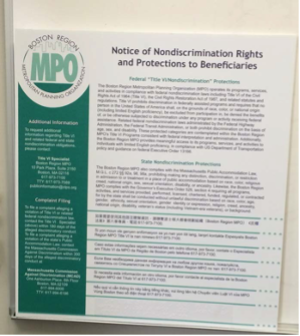
The Boston Region MPO has adopted MassDOT’s Notice to Beneficiaries and posted it on the MPO website in English and seven other languages, in accordance with the MPO's four-factor analysis. A print version of this notice is posted at the entrance to the MPO’s office and in its conference room, where public meetings sometimes are held; and a portable version of the print notice is taken to meetings outside the office.
Because of the length of the notice, not all seven translations are included in the print version. Instead, the print notice has translated riders stating, “If this information is needed in another language, please contact the Boston Region MPO’s Title VI Specialist at 857-702-3700.” The print notice posted in the office and taken to meetings also lists this rider in Braille. The MPO receptionist has copies of the full notice in 10 languages and in Braille; and a condensed version of the notice is included on meeting agendas and flyers. The following figures show various postings of the notice.
FIGURE 1
Nondiscrimination Notice on the MPO Website
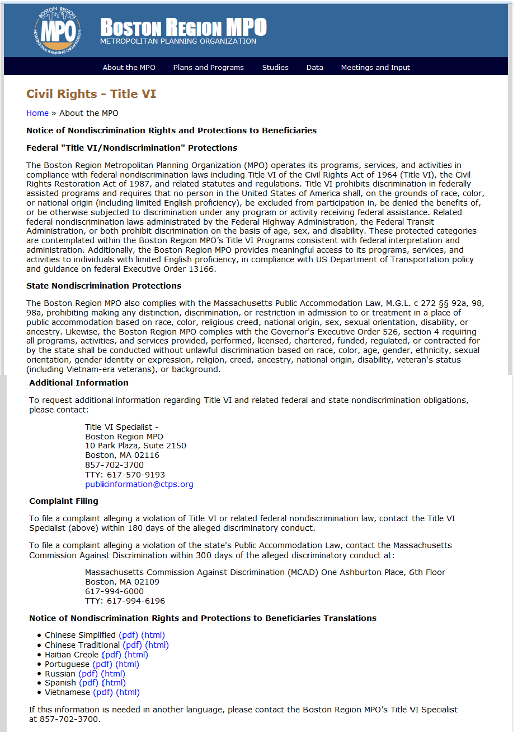
FIGURE 2
Nondiscrimination Notice Posted at the MPO Office Entrance
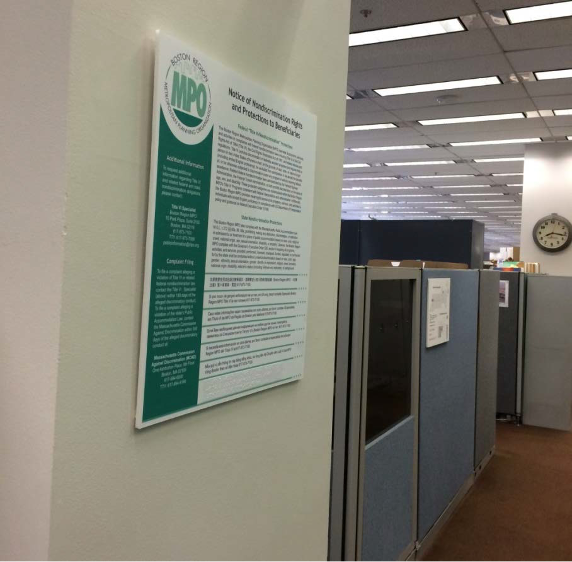
FIGURE 3
Nondiscrimination Notice in Multiple Languages at MPO Reception Area
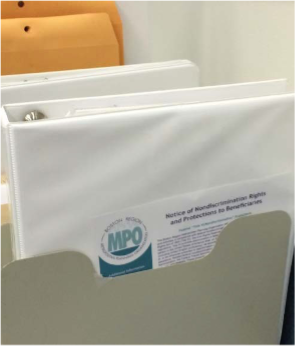
FIGURE 4
MPO Portable Nondiscrimination Notice
The MPO/RPA outreach lists require further development to reach all Title VI/Nondiscrimination populations in the region adequately and effectively. Without a recurring effort to develop these lists further, the MPO/RPAs risk omitting protected populations from participating in the planning process.
Furthermore, the MassDOT-developed online Title VI outreach tool, which is based on MPO contact lists, cannot be completed until solid MPO data has been received.
The MPO’s outreach list will be incorporated into MassDOT’s tool to provide users with contact information for diverse stakeholders across the state. The usefulness of this feature of the tool depends on robust and up-to-date data from each MPO/RPA. For this report the MPO should provide:
The MPO’s Transportation Equity database contains several hundred contacts in social-service agencies, agencies representing different ethnic and language groups, community-development corporations, immigrant groups, civic associations, senior-service agencies, councils-on-aging, disability commissions, and veterans’ organizations. New contacts are added to the MPO’s Transportation Equity (TE) contact database continuously in a number of ways, through:
Currently, contacts whose email is undeliverable are researched to determine whether they have new email addresses or if their organizations still exist.
Beginning in federal fiscal year 2016, in addition to contacts obtained from other sources, quarterly internet searches will be performed.
Contacts in the TE database receive emails that are targeted to TE issues. In the past, however, they have not received all emails that were sent to the general contact list, MPOinfo. MPOinfo has only included contacts who have requested that they receive the information distributed through this list. Staff currently are merging the TE contacts with the MPOinfo list so that they will receive general MPO information in addition to TE-specific content.
Going forward, the text below will be sent to all new TE contacts. An email containing much of this information was sent to existing TE contacts in anticipation of the public review period for the Long-Range Transportation Plan (LRTP), the TIP, and the UPWP.
The Boston Region Metropolitan Planning Organization (MPO) is responsible for conducting the federally required metropolitan transportation-planning process for the Boston metropolitan area. The 22- member MPO board, which makes decisions about how to spend federal transportation funding in the Boston metropolitan area, include representatives of the 101 cities and towns in the region, state transportation agencies, regional entities, and the Regional Transportation Advisory Council (Advisory Council)—an independent group charged with providing public input to the MPO.
Public input is an important part of the MPO’s transportation spending decisions. The MPO is particularly interested in giving a voice to individuals and groups that are sometimes underrepresented in public discussions and decision making.
We would like to keep you informed about important activities and decisions in the MPO planning process. We use an email list, MPOinfo, to send notices to interested parties concerning MPO-sponsored meetings and forums; new reports, studies, and tools; and document public review schedules. We do not send out notices often, approximately one per month. If after receiving an e-mail from MPOinfo, you decide not to subscribe, please click “unsubscribe” and we will take you off the list.
There are several other ways to participate. You can take a survey and/or share your views via the web site, http://www.bostonmpo.org. You can attend MPO and its Advisory Council’s meetings. The MPO generally meets at 10:00 AM on the first and third Thursday of each month in the State Transportation Building. The Advisory Council meets the second
Wednesday of each month at 3:00 PM in the State Transportation Building in Boston. All meetings are open to the public. Meeting agenda and minutes are posted on the MPO web site. You can subscribe to TRANSreport, the MPO’s bimonthly newsletter that contains timely information about MPO activities, studies, and reports, opportunities for public involvement, and transportation projects in the region. You can also follow the MPO on Twitter @BostonRegionMPO.
We hope that you will be pleased to be part of the MPO’s public outreach program for regional transportation decision making. Please contact Alicia Wilson at 857.702.3701 or awilson@ctps.org for additional information.
While Transportation Equity contacts do not always attend meetings or comment on documents, there is evidence that MPO outreach has been effective in other ways. A representative from a newly added immigrant group attended an MPO- sponsored forum in 2014 and, during the last year, has asked several transportation related questions via email. The MPO has also received and answered transportation-related questions from several other contacts in the TE database (examples below).
The MPO will keep track of the number of contacts added during a given fiscal year.
An accessibility check of MPO/RPA Title VI materials submitted to MassDOT indicates that there are ADA accessibility errors in the document design, structure, and content. These errors act as a barrier to access for individuals with disabilities that may be utilizing assistive technologies. The risk of noncompliance with ADA document accessibility reaches all materials developed by the MPO/RPA, but this risk is especially acute in the context of materials posted online for general public consumption. The matter of compliance in this context is not just a consideration of a best practice; it is a potential MPO/RPA risk of liability to administrative or judicial challenges that must be eliminated.
The MPO should produce accessible documents and deliverables and verify accessibility when posting/disseminating documents for the public. For regularly
produced or updated documents, the MPO should develop accessible templates. The state of Texas has developed a series of training videos on accessible-
document development and accessible electronic deliverables, which the MPO
should use to train staff involved in document production. For this report, the MPO should provide:
The MPO website and documents have been fully accessible to individuals with visual impairments since 2012. For the Central Transportation Planning Staff (CTPS) and the Boston Region MPO, document accessibility encompasses the various ways in which the needs of persons with disabilities are accommodated so that they can participate in the transportation planning work conducted by these organizations. In the case of an individual who has limited vision, an accessible document might be produced in a large-size, easy-to-read font (typically a sans serif font). In the case of an individual who is blind, an accessible document might be produced in Braille (using our in-house Braille embosser); formatted to interact with a screen reader; or read onto tape or compact disk The key to making the document and the information it conveys accessible is to provide an individual with the format that works best for him or her.
To implement these accessibility measures, the MPO invested a great deal of time researching accessibility requirements and technologies to ensure accessibility of electronic and print media produced by the MPO. As part of this effort, staff developed templates for reports, memoranda, tables, and graphics and documented the protocols for using them in the CTPS Nondiscrimination Handbook (see Appendix B). Staff are required always to use the most up-to- date versions of the templates for documents and other work products that will be posted on the MPO website. These templates, as well as the design of the website itself, were developed in consultation with the Perkins School for the Blind and the Massachusetts Commission for the Blind.
MPO staff attended mandatory training sessions when the templates were introduced (2013−14). The CTPS document accessibility committee currently is updating the templates to make them easier to use; and all staff will be trained again this fall, when the new templates are in place. This training will incorporate, to the degree possible, the video material developed by Texas. New staff will be
instructed in accessibility protocol when hired, and all staff will received refresher training annually. CTPS has included funding in its state fiscal year (SFY) 2016 operating budget to hire another editor who will be responsible for checking document formatting and working with individual staff, as needed, to ensure proper use of the templates. In addition, the Graphics staff regularly advises authors on the colors and combinations of colors that are visually appealing and provide the correct amount of contrast for individuals with low vision.
All documents on the MPO website are posted in both Portable Document Format (PDF) and HTML. Individuals with low vision can enlarge both of these formats on their screen for easier viewing. In addition, HTML documents (and to some degree PDFs) can be read by a screen reader for people who cannot see the screen. If an online document contains images—for example, tables, graphs, charts, photographs, illustrations, and so forth—that cannot be read by a screen reader, alternative text (also called “alt text”) that describes the image is imbedded in the document. Documents in other accessible formats, such as large print, Braille, or an audiotape, are provided upon request.
Occasionally, the MPO must post documents that cannot be made fully accessible or navigable using a screen reader—for example, tables that summarize all TIP projects must conform to formatting defined by MassDOT; and specific FTA and FHWA Title VI Certifications and Assurances forms must be included in the MPO’s triennial Title VI Program reports. In such cases, the MPO uses alt text or gives an explanation in the body of the document that explains the content of the non-accessible material and provides instructions about who the reader may contact for assistance.
MPO/RPA certification documents call for equity analyses to understand the implications of planning and programming activities on the region’s protected populations. These analyses require more than articulating a demographic profile for the region. The required analysis should include study of project and other data for identifying possible disparate impacts in the articulation of transportation improvement programs on Title VI/Nondiscrimination populations. Further, a good Title VI analysis should describe the MPO/RPA efforts to develop certification documents that avoid, minimize, and/or mitigate any disparities.
According to FHWA and MassDOT guidance, LRTPs currently under development should reflect regional equity considerations. This can be demonstrated throughout the document including the establishment of regional
transportation priorities, goals, objectives, as well as long-range project proposals. For this report the MPO should provide:
The MPO systematically integrates equity concerns into the transportation planning process in a number of ways. At the highest level, equity is part of the MPO's central vision statement, and therefore is reflected in the MPO's goals and objectives. Equity concerns also are integrated by considering feedback from all outreach activities, including TE outreach, and the ongoing public involvement that routinely occurs during development of the LRTP, TIP, UPWP, and other MPO studies.
In addition, equity is one of the factors the MPO considers when selecting studies for the UPWP, and it is integrated into the project selection criteria for the LRTP and TIP. Finally, staff performs equity analyses on the recommended projects in the draft LRTP to evaluate the effects on access, mobility, congestion, and air quality for TE populations. Appendix E contains the Transportation Equity Chapter from the LRTP, which explains the equity analyses performed for the Plan. Although the equity analyses conducted for this LRTP look only at impacts on minority and low-income populations, the MPO plans to increase the number of protected populations covered in the future. The FHWA Title VI/Nondiscrimination Program requires MPOs also to consider and analyze equity impacts based on age, sex, and disability. In the coming year, staff will investigate data sources and analytic techniques to determine the most effective and appropriate ways to incorporate these populations into equity analyses.
The MPO also plans to fund a study in the FFY 2016 UPWP that will evaluate methods for performing more sophisticated equity analyses on the TIP. Such analyses would help to ensure the equitable distribution of benefits and burdens for projects that are not individually listed in the LRTP because either 1) they are not regionally significant, or 2) cost less than $20 million; and will be funded using money set aside in an LRTP program that will support operations and management-type projects, such as intersection improvements or expansion of bike and pedestrian infrastructure. The specific projects funded through these programs will be selected using the TIP project-selection criteria, which include equity concerns. They also will be subject to the TIP equity analysis.